Seven Tried and True Methods of Taming Physical and Emotional Turbulence
 Forget Eden. Life on planet Earth is a crucible. So what else is new?
Not that there aren’t wonders and pleasures, joys and inspirations. Of course there are. Although there are those who would find those diversions troublesome. Go figure.
But since the design of our lives and our environs positions the lovely and the alluring at counterpoint to the rough and the gruff, we’re best off if we develop effective coping methods, all the better to enjoy what is pleasant, and even what is mundane.
My grandmother had an expression that captures the essence of our plight. She would say, “The hard stuff will put hair on your chest” — which gives you an idea about the value of women versus men in the 1950’s when I was growing up. Today, common parlance expresses a more gender-neutral phrase: “what doesn’t kill us will make us strong.”
Most people would rather be strong than dead, I presume. Anyway, here we are, in a place where living with stress is a given and navigating stress is a necessity.
I’ve created a Seven Solutions Cheat Sheet as a guide for navigating the ‘stuff’ which will often or occasionally but inevitably appear to ruin our day.
1. Our breath. We are gifted with this built-in tranquilizer which is both involuntary and voluntary. While we breathe without conscious participation, you must have noticed that sometimes when stress stops us in our tracks, we hold our breath. It is especially at these moments that we need to volunteer to take a deep inhalation, all the better to experience the relief of an exhale.
When stress intrudes, try this:
Notice how you’re feeling at the moment.
Rate it on a scale from 1 to 10.
1 = I’m as relaxed as a rag doll;
10 = I’m about to jump out of my skin.
Take one long, slow deep inhalation, and release as much tightness as
you can on a long, slow exhale.
If you rate your stress level as a 7 on the scale, taking and releasing a generous breath now is likely to move the needle down to at least a 6.
If not, repeat.
If you felt relief with one or perhaps two breaths, imagine the value of breathing freely, easily and generously on purpose – for sixty seconds. Or for five minutes, if you need more time to experience a shift. Are you especially out of sorts? Keep breathing with awareness until your breath gives your body the message that it is safe to let go and let down. Using a timer might clarify the time it takes to return to neutral.
The breath is a guaranteed way out of a mental and/or a physical grip, if you can remember to use it. Surprisingly, some folks don’t.
2. The Relaxation Response is a stress-relieving tool popularized in the 1970’s by Dr. Herbert Benson of the Mind/Body Institute at Harvard University. This technique requires an investment of a few more minutes than the time it takes for one or two deep breaths. But it is also based on the capacity of purposeful breathing to change our state when one of life’s curve balls zonks us.
This technique takes a little planning.
First, decide on a word to which you have a positive association, that you can say to yourself on each exhale. An example of a word might be ‘sunshine’ or some other reference to nature.
Alternatively, you can choose a phrase – half of which you say to yourself on the inhalation, and the other half you say on the exhalation.
An example of a phrase might be, ‘now I’m breathing in… (on the inhalation); now I’m breathing out’… (on the exhalation).
Stay with repeating your word, phrase, (or prayer, if you prefer) over and over as described above, with the understanding that you are likely to lose your place. If so, let it go without judgement and start over.
And again, setting a timer establishes the expectation that you will feel more at ease when it br-r-r-ings.
3. Negative thinking is the most common stress producer. This technique is a reliable way to manage the live-in naysayer that we all need to contend with.
The Process:
Capture one or more negative thoughts, ruminations or commands that the trouble-maker part of your mind presents you with.
Write it (or them) down.
Select one to work with.
Then say to yourself (or out loud) …
…now my mind is telling me, followed by the negative thought.
(For example, ‘now my mind is telling me I’ll never get pregnant’)
Repeat your phrase over and over for a predetermined amount of time.
I know it is counterintuitive to honor the negative thought, but by letting it have its say, it slinks off into the sunset, giving you a reprieve.
The stress producer can become a stress reducer. Hard to believe? Give it a try.
4. Recruit the tranquilizing power of nature.
Utilize the beauty, the power, the distractability of all things ‘nature.’
Notice how you feel.
Now find your way (real or imagined) to being ‘with’ nature, whether it is reveling in the glory of a sunny day, safely watching the intensity of a rain, wind or snowstorm, or simply exalting in the beauty of a lone tree in the middle of a meadow.
Notice what phenomena catch your attention?
Encourage your mind to ‘tour’ the landscape.
Wonder and wander through the scene for real or in your imagination with all of your senses – sight, sound, smell, taste, touch. What does your sixth sense reveal to you?
Notice in what way this imaginary journey impacted your state of mind?
How did it impact you physically?
5. Move a muscle, change a mood.
Begin by noticing your posture and your state of mind:
Make any physical adjustments needed to feel ready to start with this exploration.
And how would you define your mood?
*Starting at you head, or at your feet, slowly and without judgement, traveling up (or down), ask each part of your body if there is physical comfort or discomfort.
*Make note of what messages you receive from various muscles, tendons, bones, organs.
*Now either bend over, jump up and down, twist back and forth at the waist or disorient yourself in any other way from the state you were in.
*As an alternative, stand up, stomp your feet several times, and then pay attention to the vibration that travels through your legs, into your torso and arms and finally impacting your state of mind.
*Then center yourself so you can gauge your overall feeling.
*Can you determine how each body part feels compared to what you observed at the outset?
When you moved your muscles, did your mood change? If so, how?
6. Are you in a Bio-Psycho-Socio-Spiritual Crisis?
Perhaps now is a good time to stop and evaluate if you feel the need to connect with a Higher Being, whatever that means to you. And once you sink into that ‘connection’ how do your mind and body respond? Does it alter your orientation toward others? Toward yourself? Does spiritual connection inspire you to believe that you can find a satisfactory way to experience the crisis?
7. Use your mind to ‘enter’ your body for healing.
Can you allow yourself to believe that, in a meditative state, you can empower yourself to take a ‘fantastic voyage’ where you mentally ‘travel’ through your body inviting healing energy to soothe whatever ailment is blocking your physical and emotional wellbeing? Can your mental or physical condition be ‘coaxed’ into neutrality by using your thoughts to ‘enter’ your bodymind in a way that your thoughts can feel medicinal?
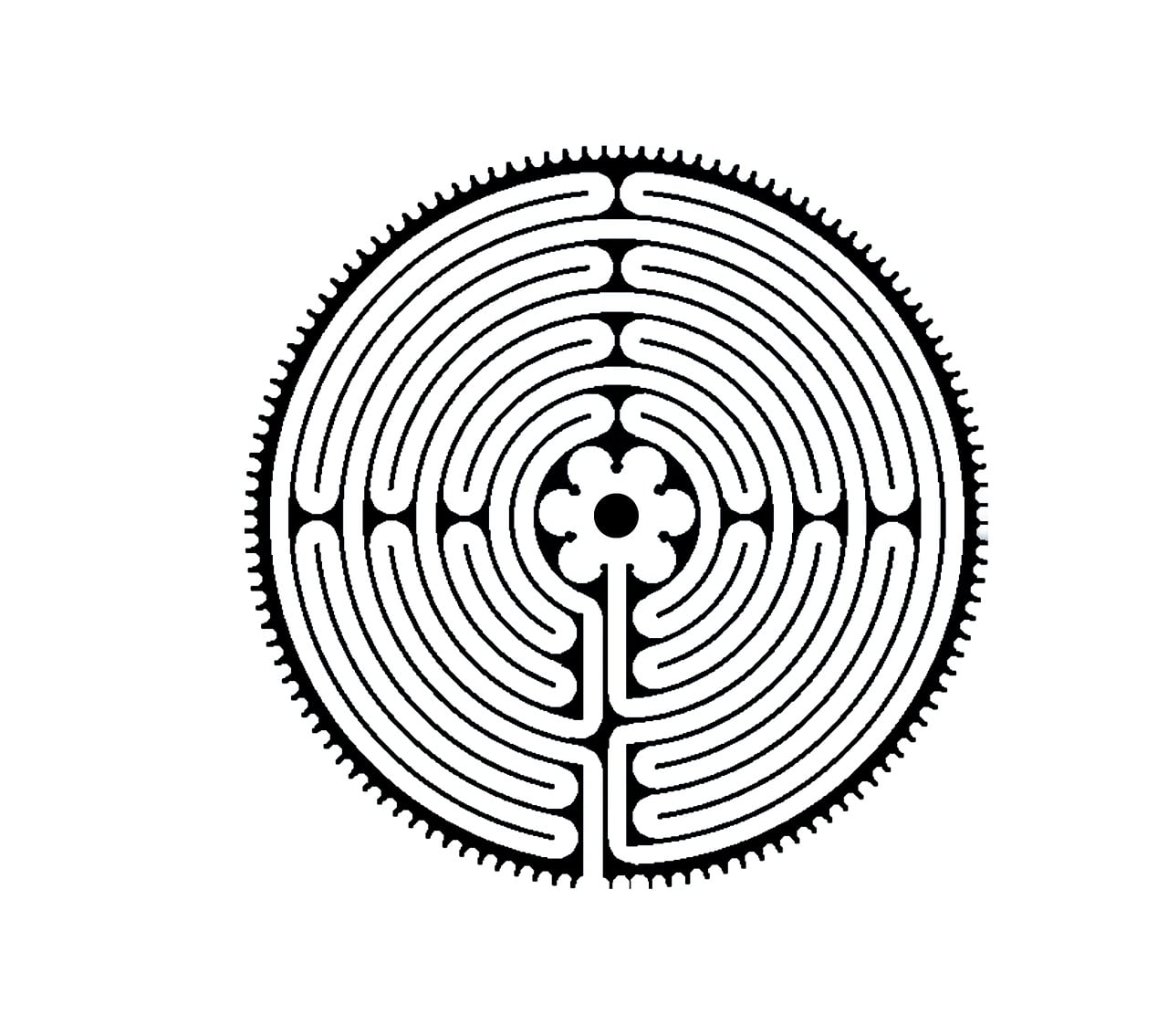 8. Download a Labyrinth (or find out if there is one you can go to locally).
A paper labyrinth of the one found at Chartres is recommended. Trace the path slowly, letting your mind wander. When you arrive at the center, continue to let your mind present you with what has been evoked on the ‘journey.’ Make note or memorize what comes up. Traverse the path back out, continuing to capture the ‘gifts’ that get tossed up by your unconscious mind.
Life is a crucible, a quandary, a predicament. You use this cheat sheet to reduce the stress that is inevitable if you live on planet earth.
Without options like these – you are at risk of swirling clockwise down the drain. Unless you live in Australia.